The DevoxxGenie Plugin Goes Agentic

DevoxxGenie has come a long way from its origins as a simple LLM chat plugin for IntelliJ IDEA. With the latest releases, the plugin has made a fundamental shift — from passive AI assistance to agentic AI capabilities. This reflects a paradigm shift in how developers interact with AI: we're moving beyond generating code snippets toward autonomous agents that can explore, reason about, and modify your codebase.
Agent Mode with Parallel Sub-Agents
The centerpiece of this evolution is Agent Mode. When enabled, the LLM doesn't just answer questions — it autonomously explores your codebase through seven built-in tools:
read_file— inspect project fileswrite_file— create new filesedit_file— modify existing codelist_files— browse directoriessearch_files— find patterns via regexrun_command— execute terminal commandsparallel_explore— spawn concurrent sub-agents
Read operations auto-approve for efficiency, while write operations require explicit user confirmation via a diff preview. You stay in control.
Parallel Sub-Agents
What makes this especially powerful is parallel sub-agents. Multiple read-only AI assistants can investigate different parts of your project simultaneously. Each sub-agent operates with:
- Isolated memory (no cross-contamination)
- Independent tool budgets
- Potentially different LLM providers
The main agent synthesizes their findings into a comprehensive response. This opens up interesting cost optimization strategies — use smaller, cheaper models like Gemini Flash or GLM 4.7 for sub-agents, while keeping a powerful coordinator like Claude Opus or GPT-4 as the main agent.

MCP Marketplace
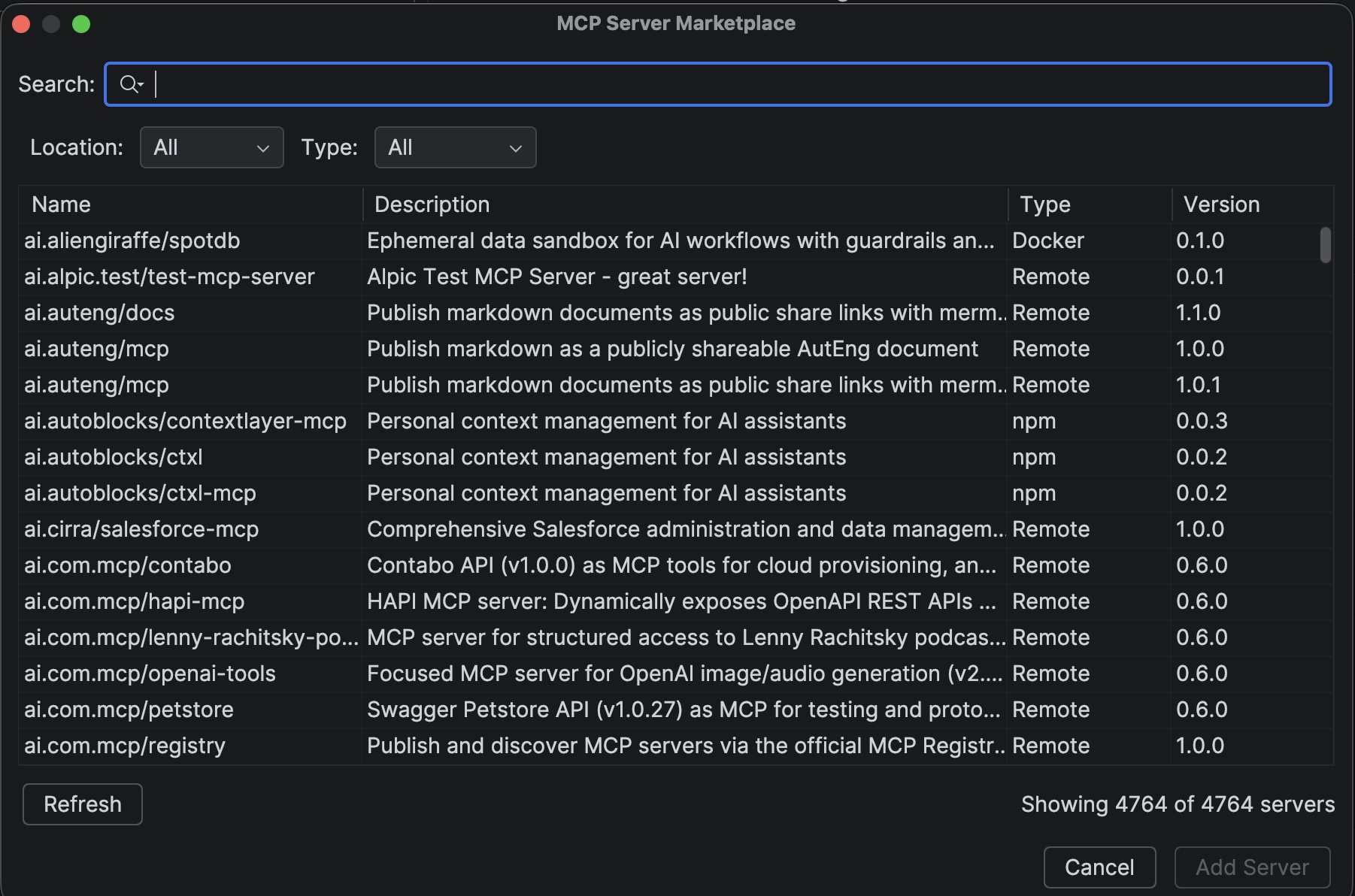
DevoxxGenie now integrates the Model Context Protocol (MCP), allowing agents to access external services — databases, APIs, documentation, cloud infrastructure — through standardized tool interfaces.
The built-in MCP Marketplace connects to an official MCP server registry, making it easy to discover and install servers with just a few clicks. No more manual configuration of JSON files or hunting for compatible servers.
Inline Code Completion
For developers who want AI assistance without the overhead of a full conversation, DevoxxGenie now offers real-time inline code completion using local Fill-in-the-Middle (FIM) models.
Key characteristics:
- Runs entirely locally via Ollama or LM Studio — your code never leaves your machine
- Smart post-processing: suffix overlap detection, leading newline stripping
- Caching: recent completions are cached for instant retrieval
- Configurable: debounce delay (100–2000ms), max tokens (16–256), timeout (1–30s)
Supported models include StarCoder2 3B, Qwen 2.5 Coder, and DeepSeek-Coder — all running locally for complete privacy.
Built for Developer Control
DevoxxGenie is built entirely in Java using Langchain4J and supports both local providers (Ollama, LM Studio, GPT4All, Llama.cpp) and cloud services (OpenAI, Anthropic, Google Gemini, Mistral, DeepSeek, and more). With over 42,000 downloads on the JetBrains Marketplace, it's become a go-to tool for Java developers who want flexibility in their AI tooling.
The plugin prioritizes developer control across every dimension:
- Model selection — use any provider, switch freely
- Approval workflows — confirm writes before they happen
- Spending — track token costs in real-time
- External service access — MCP tools are explicitly configured
- Code privacy — local models for sensitive codebases
What's Next
This is just the beginning. With Spec-driven Development (SDD) now available in v0.9.7, you can define tasks as structured specs and let the agent implement them autonomously — complete with acceptance criteria tracking and a visual Kanban board.
We're not just chatting with AI anymore. We're collaborating with it.
Try it out: